FIFA International Soccer Wasn't the Best Football Game of 1993
Oct 18th '26 9:31am:
Written by: GEmmo
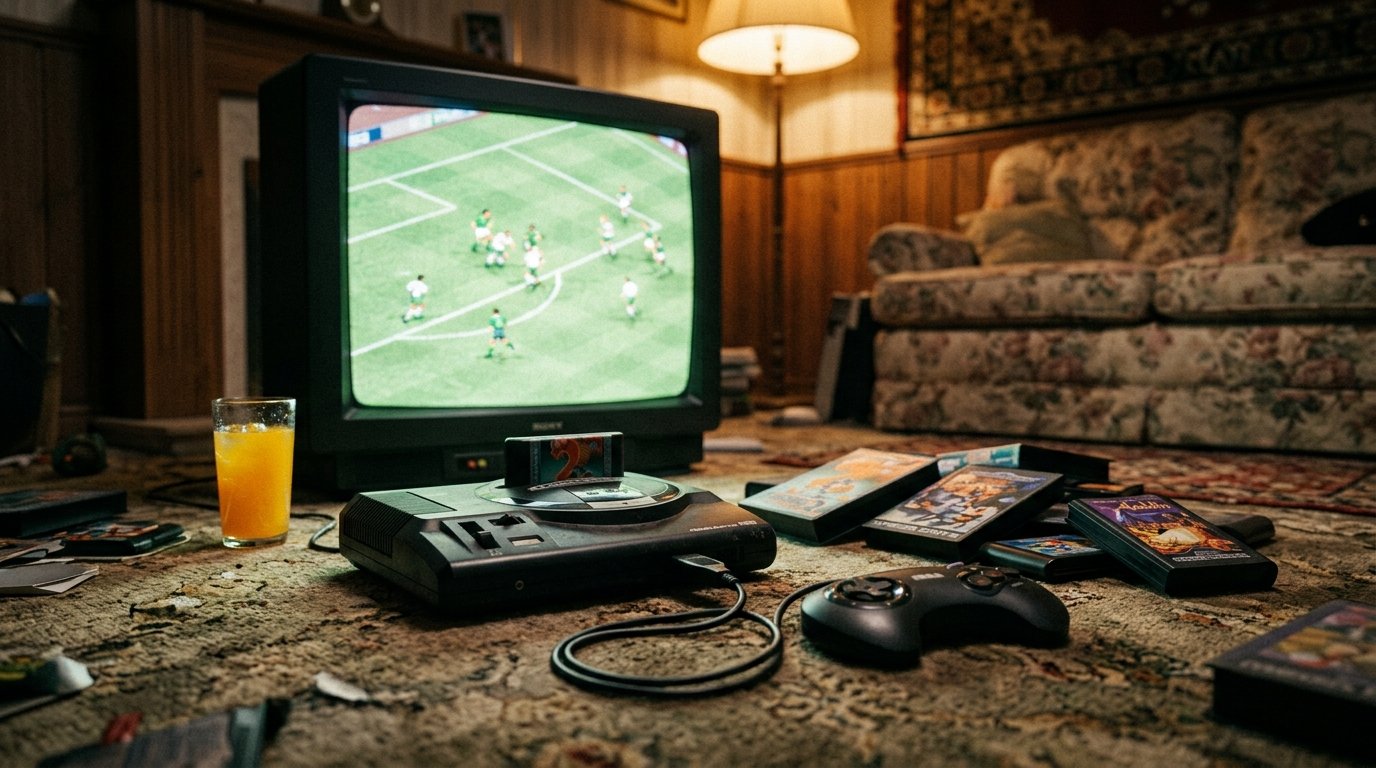
<br>In December 1993, Electronic Arts shipped a football game for the Sega Mega Drive (the Genesis in North America) that had no real player names, no club teams and a camera angle that football purists thought was a mistake. It was **FIFA International Soccer**, the first game to carry the FIFA name, and it quickly became the Christmas football game for a generation of console owners. Three decades later, that same lineage had grown into one of the best-selling sports franchises ever made, before a licensing fight forced it to change its name.
## What FIFA International Soccer actually was
It's easy to inflate this game into something it wasn't, so here is what shipped.
- **Developer:** EA Canada, working out of Burnaby, near Vancouver, under the EA Sports label that EA had introduced a couple of years earlier
- **Platform at launch:** Sega Mega Drive / Genesis, December 1993, with versions for the Master System, Game Gear, Super Nintendo, Mega-CD, 3DO and PC following during 1994
- **Teams:** national sides only, around 48 of them, since the FIFA license covered national teams and not clubs
- **Players:** no real names; the squads carried generic ones, because the player-rights side of the license wasn't there yet
- **Camera:** a three-quarter isometric view that gave the pitch a fake sense of depth, instead of the flat top-down view of its rivals
- **Controls:** the standard Mega Drive three-button pad, with one button for passing, one for shooting and one for sprinting
None of that sounds revolutionary on paper. The revolution was in how it felt in a room full of people, and that part is harder to put in a spec sheet.
## The market it walked into
The football game on the Mega Drive in 1993 wasn't an empty field. Sega had its own sports line. Sensible Soccer, released in 1992 on the Amiga and ported to consoles, had a loyal following that treated it as the benchmark for how a football game should play. Kick Off and its sequels held the other pole of the purist argument, with a ball that behaved like a physical object and a difficulty curve that punished the careless.
These games shared a philosophy: the player is a coach with a joystick, and the game is about control, angles and a ball that never quite sticks to your foot. They looked small and abstract because the pitch had to fit on the screen. They played brilliantly if you invested the hours.
EA made a different bet. A console game in a living room competes with a friend, a sibling or a cousin who just wants to play for twenty minutes and shout at the television. Sensible Soccer asked for commitment. FIFA asked for a pad.
## Why the isometric camera mattered more than the gameplay
Whenever someone says FIFA International Soccer "looked better" than its rivals, the real claim is narrower and more interesting: it looked **like television**. The players were bigger, the pitch had perspective, and the camera seemed to sit where a broadcast camera would sit. For a kid watching on a 14-inch CRT, that changed everything about what a football game was supposed to be.
The cost was real. Passing in an angled view is imprecise because depth is hard to judge, and anyone who played the game seriously remembers the odd moments where the ball seemed to float between two players who looked, on screen, to be close together. Judged purely as a simulation of football, the game was loose.
But judged as a product, it solved a problem that Sensible and Kick Off never tried to solve: it made football look like something you already knew from the TV. The *feeling* of watching football was in the box, even if the physics weren't quite there.
## The license was the real feature
This is where the story gets less nostalgic and more interesting. The FIFA name on the box was a product feature in itself, perhaps the most important one.
In 1993, a football game with the FIFA name on it implied something close to official status. The game could say, in effect, *this is the sport*. The limits of that license are what make the history odd. National teams, yes. Club teams, no. Real player names, not yet. Players like Lothar Matthäus or Gianluca Vialli, then playing at the top of the game, weren't in it by name. EA was selling a promise of authenticity that the data inside didn't fully back up.
What EA understood early was that the license is a **ratchet**. You buy the right to say "official" once, then you spend the next decade adding what's missing: real names, real kits, real leagues, real stadiums. Every year the gap between "official" and "actually official" shrinks, and every year there's a new reason to buy. FIFA 96 brought in real player names through the players' union, FIFPro, and motion-captured movement. The yearly cycle that football fans now take for granted starts here, with a game that was officially licensed and visibly unfinished.
## A pattern from the last thirty years
The pattern I keep noticing across football-game history is that quality and dominance are less connected than fans like to say. Konami's International Superstar Soccer on the Super Nintendo in 1995, and later Pro Evolution Soccer in the early 2000s, were widely considered the better *football* games for years. Critics said so. Forums said so. Entire friend groups split into camps and stayed that way into adulthood.
And yet the sales never followed that argument. FIFA kept the stadium. It kept the licenses, it kept the shelf space, and it kept the habit of the annual purchase. The better simulation lost to the better *package* over and over, and I'd argue the first sign of that was already visible in December 1993, when a looser game with a bigger name outran the stricter ones.
That isn't a cynical reading. Packaging matters because football is a social sport, and people buy the game their friends have. If your cousin owns FIFA, you play FIFA. A game can be the best at a sport and still lose the living room.
## What got left out of the retelling
Nostalgic accounts of this game usually go quiet on three things.
First, the game was not alone in being rushed. Sports titles of that era were built to a release window, usually the holiday season, and a fixed window affects what makes it into the box. The missing player names weren't a creative decision. They were a consequence of what the deal covered and what the calendar allowed.
Second, the version you remember depends on where you lived. Mega Drive owners in Europe, where the console was dominant, had a very different relationship with this game than someone playing the Super Nintendo port, or the 3DO edition, which was a different kind of experiment altogether. People argue about "FIFA 94" as if it were one object. It was several, on different hardware, with different frame rates and different controller layouts, and the memory of it blurs them.
Third, and this one is a little uncomfortable: the sales numbers that circulate for the early games are loose. You will see figures in the range of a million-plus copies attached to the Mega Drive release, but those numbers pass from article to article without a clean source behind them. I'd treat them as an order of magnitude, not a fact to put on a poster.
## From a Mega Drive cartridge to a rebrand
What came after is easier to document. The series released a new edition every year. It moved from sprites to polygons in the mid-90s, then to the HD generation, then to online modes that turned the game into a service. By the early 2020s EA described the franchise's lifetime sales as exceeding 325 million copies, which is the kind of number that makes a Mega Drive cartridge feel like a rounding error.
Then the relationship broke. In 2022 EA and FIFA announced they would part ways, with reports that FIFA was seeking a far larger fee for the next licensing cycle. EA's football game became **EA Sports FC** in 2023, keeping the engine, the clubs and the modes, and losing the name that had been on the box since 1993.
I find that ending more telling than anything in the early history. For thirty years the FIFA name was supposed to be the thing that made the game *the* football game. When it left, the audience mostly followed the game, not the badge. The license that had been the whole selling point in 1993 turned out, by 2023, to matter less than the habit it had helped build.
## The bit nobody wants to admit
Here is the opinion I'd stand behind: FIFA International Soccer was not a great game, and that is exactly why it's worth studying. It was a *good-enough* game, wrapped in the right name, at the right moment, on the right console, shipped to people who wanted football on their television more than they wanted a perfect passing model. Everything about the series that came later, the annual cycle, the licensing ratchet, the emphasis on presentation, is visible in embryo in that first cartridge.
Which leaves a question I can't settle. If the better-playing game had taken that Christmas, the one with the flat camera and the exacting ball, would football games have turned out better, or would we just have a different, smaller franchise and a lot more arguments about passing physics?